
Convergence Insufficiency: Symptoms, Testing and Vision Therapy in Rancho Santa Fe
Headaches, tired eyes, or blurry or double vision when you read or use a screen can mean your eyes are not teaming well up close. Here is how convergence insufficiency is found and treated.
 Last reviewed: Dr. Lisa Weiss, O.D. | 10/14/2026
Quick Answer
- Convergence insufficiency (CI) means your eyes have trouble turning inward together for reading, phones and other close work.
- Signs include eyestrain, headaches, blurry or double vision, and losing your place.
- Routine eye exams and school screenings often miss it.
- In a large NEI-funded trial, office-based therapy with home practice worked best.
Call (858) 756-3210 to request a binocular vision evaluation.
What is convergence insufficiency?
To read or look at a phone, both eyes turn slightly inward, or converge, so they stay pointed at the same spot. With convergence insufficiency, the eyes do not turn in enough, and one eye may drift outward.
It is an eye teaming problem, not an eyesight problem. You can see 20/20 on an eye chart and still have convergence insufficiency.[2]
What causes it?
The cause is often unknown.[1] The American Optometric Association describes it as a communication problem between the nerves and the eye muscles; the eye muscles themselves are strong.[2] A family history raises the risk, and convergence insufficiency can also follow trauma, brain disease or autoimmune disease.[3] Brain injury and Parkinson’s disease can cause it as well.[4]
Convergence insufficiency symptoms checklist
During or after reading or screen work, do you or your child notice:
Checked several? Call (858) 756-3210 to request a binocular vision evaluation or vision therapy evaluation.
How convergence insufficiency is diagnosed
Why a standard eye exam or school screening can miss it
Most routine eye exams and school vision screenings do not test for convergence insufficiency, so it is often missed.[2] If reading or screen work brings on symptoms, describe them to your eye doctor in detail.
What testing looks like
- Symptom history. Research studies use a symptom questionnaire called the CISS (Convergence Insufficiency Symptom Survey).[1]
- Near point of convergence: how close the eyes can stay together before an object doubles.[5]
- Fusional vergence: how much prism the eyes can handle before an object doubles.[5]
- Eye alignment at distance and near, measured with prisms.[3]
- Glasses prescription and focusing checks.[5]
What to ask for at your appointment
- Mention any symptoms that show up during reading, homework or screen work.
- Ask whether eye teaming and convergence will be tested.
Your binocular vision evaluation at RSF Optometry
To get started, request a binocular vision evaluation or vision therapy evaluation. This visit is where we make the initial diagnosis and build your treatment plan. It includes a full 21-point binocular exam, including:
- Stereo depth perception: how well the eyes work together to judge depth
- Near point of convergence: how close the eyes can stay together before doubling
- Cover testing: checks whether an eye drifts when the other eye is covered
- Vergence ranges at distance and near: how far the eyes can turn in and out together while keeping one clear image
Think you or your child might have convergence insufficiency? Call (858) 756-3210 to request a binocular vision evaluation or vision therapy evaluation.
Convergence insufficiency treatment options compared
What the research shows for each option. Success rates and symptom scores are from the NEI-funded CITT trial in children aged 9 to 17; a lower symptom score means fewer symptoms.[6]
| Option | What it is | What the research shows |
|---|---|---|
| Office-based vergence/accommodative therapy with home practice Best results in children |
Weekly hour-long office sessions with a trained therapist, plus home exercises (CITT design)[7] | 73% successful or improved at 12 weeks; lowest symptom score (15.1).[6] A 2020 Cochrane review found it more effective than home pencil push-ups or home computer therapy in children.[10] |
| Home pencil push-ups | Following a small target, such as a pencil tip, toward the nose[7] | 43% successful or improved at 12 weeks; symptom score 24.7.[6] Cochrane found no clear difference from placebo for treatment success (low-certainty evidence).[10] |
| Home computer therapy (with pencil push-ups) | Vision therapy software used at home | 33% successful or improved; symptom score 21.3.[6] |
| Placebo office therapy (comparison only) | Sham activities used for comparison in the trial | 35% successful or improved; symptom score 21.9.[6] |
| Base-in prism reading glasses | Glasses that help keep the eyes aligned for reading | One adult trial: fewer symptoms than placebo glasses at 3 months, with no change in convergence measures.[10] AAPOS notes prisms may reduce gains in convergence ability,[5] and the AOA calls prisms a “crutch” that works only while worn.[2] |
| Surgery | Eye muscle surgery | Rare; for people who do not improve with other treatment.[3] |
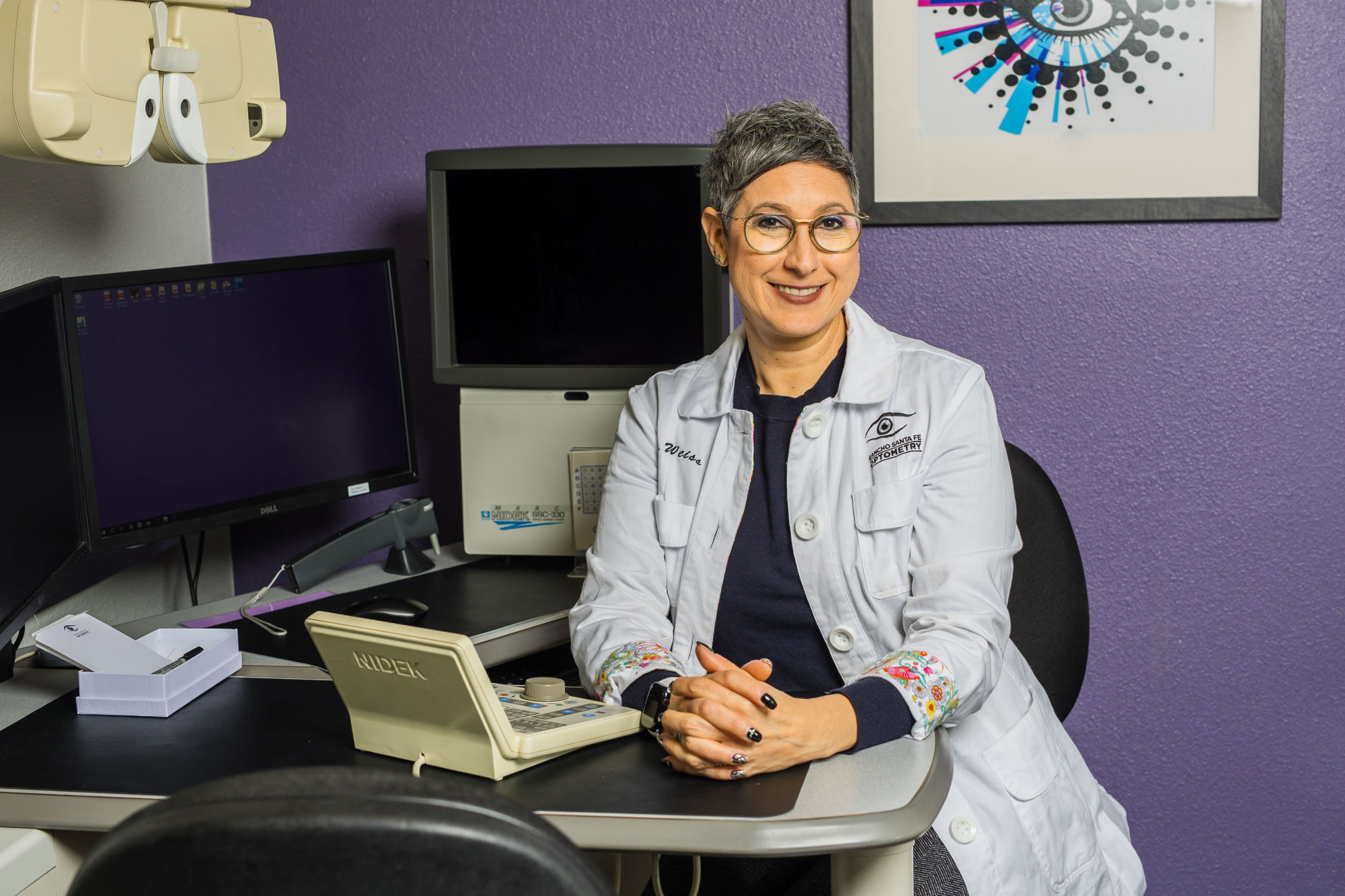
Vision therapy for convergence insufficiency at RSF Optometry
Our vision therapy program follows the same basic approach that worked best in research: therapy in the office plus practice at home.[6] Every plan starts with a binocular vision evaluation or vision therapy evaluation.
40 minutes each
In our Rancho Santa Fe office
With the equipment we provide
What the research shows, and what it does not
- CITT (2008): Office-based therapy with home practice gave the best results for symptoms, near point of convergence and fusional vergence.[6]
- CITT-ART (2019): In 310 children aged 9 to 14, 16 weeks of office therapy improved the clinical signs of convergence insufficiency but did not improve reading test scores compared with placebo (3.68 vs 3.80 points).[9]
- In plain language: Therapy aims at comfortable eye teaming. It is not a reading program.
- Symptoms can return after illness, lack of sleep or a lot of close work, and another round of therapy may help.[1]
How long does treatment take?
It can take 12 weeks or more (three months or more) to notice a change, according to the National Eye Institute and Cleveland Clinic.[4]
The American Optometric Association notes that active treatment can last up to 90 days or more, and that results are typically permanent.[2] The major trials ran for 12 weeks (CITT) and 16 weeks (CITT-ART).[6]
Convergence insufficiency after a concussion
Convergence insufficiency is common after a brain injury or concussion.[1] In a Children’s Hospital of Philadelphia study of 100 adolescents (ages 11 to 17) seen after a concussion:[11]
The CONCUSS randomized clinical trial, published in 2025, studied office-based vergence/accommodative therapy in people aged 11 to 25 with concussion-related convergence insufficiency. After six weeks, symptoms had improved in 79% of those who started therapy right away, compared with 13% of those whose therapy was delayed. Once both groups had completed 16 sessions, their results were similar, and the researchers concluded that starting therapy promptly shortened how long symptoms lasted.[12]
Learn more about our vision therapy for concussion and head injury, care for head injuries and stroke, and neuro-optometric rehabilitation.
Still having eyestrain or reading trouble after a concussion? Ask about a binocular vision evaluation: (858) 756-3210.
Convergence insufficiency, reading and school (CI vs ADHD)
Convergence insufficiency can cause trouble concentrating and a short attention span during reading,[2] which can look like an attention or reading problem.
The American Academy of Ophthalmology notes that learning disabilities are not caused by convergence insufficiency or other eye problems, although some children have both.[3] And in the CITT-ART trial, therapy did not improve reading test scores compared with placebo.[8]
That is why we recommend an eye teaming evaluation as one part of the picture, alongside your pediatrician, your child’s school and any learning specialists.
Convergence insufficiency in adults and screen-heavy work
Convergence insufficiency is not only a childhood condition.
Adults can have it
Adults can have convergence insufficiency, including after a brain injury.[4]
Close work brings it out
Symptoms tend to show up with close work such as phones, tablets and computers.[1]
What the evidence says
Research on treatment in adults is less clear than in children.[10] Every plan starts with your own evaluation.
Read more about vision therapy for adults, or schedule an adult comprehensive eye exam.
Serving Rancho Santa Fe, San Diego and North County
Rancho Santa Fe Optometry has provided eye care, including vision therapy, to North County San Diego for over 30 years. We welcome children, teens and adults from Rancho Santa Fe, Del Mar, Solana Beach, Encinitas, Carlsbad and across San Diego.
Looking for a nearby eye doctor? See our pages for Encinitas and Solana Beach.
Rancho Santa Fe Optometry
- 6037 La Granada, Suite A
Rancho Santa Fe, CA 92067
Get directions - (858) 756-3210
- info@rsfoptometry.com · Contact us
Frequently asked questions
What is convergence insufficiency?
Convergence insufficiency is an eye teaming problem where the eyes do not turn inward enough for close work. It can cause eyestrain, headaches, and blurry or double vision.[2]
Can you have convergence insufficiency with 20/20 vision?
Yes. Sharpness and eye teaming are different skills, and school screenings often miss convergence insufficiency.[3]
If my child has no symptoms, do they need treatment?
Not necessarily. Tell the eye doctor if symptoms appear.[3]
Is convergence insufficiency the same as ADHD?
No. Convergence insufficiency can make it hard to concentrate while reading, but it is an eye teaming problem and does not cause learning disabilities.[2]
Is vision therapy a reading or dyslexia treatment?
No. In the NEI-funded CITT-ART trial, therapy improved eye teaming but did not improve reading test scores compared with placebo.[8]
Do pencil push-ups work for convergence insufficiency?
In the CITT trial, 43% of children doing home pencil push-ups were successful or improved after 12 weeks, compared with 73% who had office-based therapy plus home practice.[6]
Will prism glasses fix convergence insufficiency?
They may ease symptoms while worn, but research has not shown they improve convergence itself.[5]
How long does treatment take?
It can take 12 weeks or more to notice a change.[1]
Can convergence insufficiency come back after treatment?
Yes, for example after illness, lack of sleep or lots of close work. Another round of treatment may help.[5]
Can a concussion cause convergence insufficiency?
Yes. Convergence insufficiency is common after a concussion.[11]
What does vision therapy at RSF Optometry involve?
Typically 10 to 15 forty-minute office sessions once a week, plus 10 to 15 minutes of home practice each day with equipment we provide. Home therapy varies by patient.
How do I get tested for convergence insufficiency?
Request a binocular vision evaluation or vision therapy evaluation at RSF Optometry by calling (858) 756-3210.
Schedule a binocular vision evaluation
Book your binocular vision evaluation with RSF Optometry. Call (858) 756-3210 or contact us online.
Every vision therapy plan starts with this evaluation, for children, teens and adults.
Dr. Weiss graduated from Pacific University College of Optometry, then completed a residency in Vision Therapy and Rehabilitation at the SUNY State College of Optometry in New York. She earned her fellowship in the College of Optometrists in Vision Development and is a Diplomate of the American Board of Optometry. She is a member of the Neuro-Optometric Rehabilitation Association and the College of Syntonic Optometry. Meet Dr. Weiss
Sources
- National Eye Institute. Convergence Insufficiency.
- American Optometric Association. Convergence insufficiency.
- American Academy of Ophthalmology. What Is Convergence Insufficiency?
- Cleveland Clinic. Convergence Insufficiency.
- American Association for Pediatric Ophthalmology and Strabismus. Convergence Insufficiency.
- Convergence Insufficiency Treatment Trial Study Group. Randomized clinical trial of treatments for symptomatic convergence insufficiency in children. Arch Ophthalmol. 2008.
- National Eye Institute. More effective treatment identified for common childhood vision disorder. 2008.
- National Eye Institute. Treatment for common vision disorder does not improve children’s reading skills. 2019.
- CITT-ART Investigator Group. Effect of vergence/accommodative therapy on reading in children with convergence insufficiency. Optom Vis Sci. 2019.
- Cochrane network meta-analysis. Interventions for convergence insufficiency. 2020.
- Children’s Hospital of Philadelphia, Center for Injury Research and Prevention. Vision disorders are common after concussion in adolescents.
- Alvarez TL, Scheiman M, et al.; CONCUSS Investigator Group. CONCUSS randomised clinical trial of vergence/accommodative therapy for concussion-related symptomatic convergence insufficiency. Br J Sports Med. 2025.